

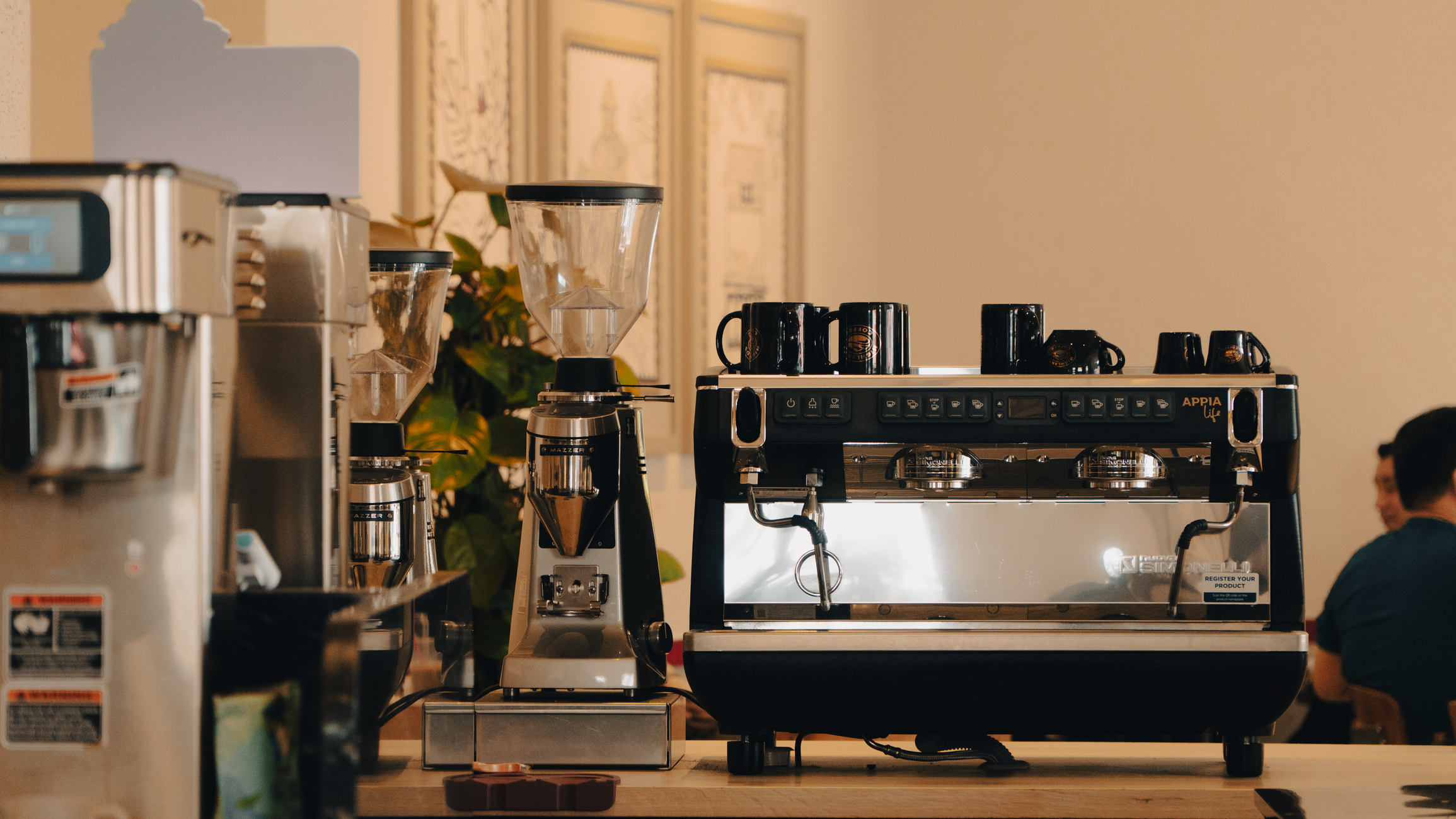
Shop for a grinder and you will drown in brand loyalty. Forums argue about manufacturers the way people argue about cars. But if you strip away the housing, the motor, and the logo, what actually touches your coffee is a pair of burrs, and the material those burrs are made from does more to shape your cup than the name stamped on the side.
Two grinders from different companies with the same burr geometry and material will produce more similar coffee than two grinders from the same company with different burrs. That is worth knowing before you spend money.
Whatever you grind with, it only matters if the beans deserve the effort. Have a look at our most popular roasts and give your grinder something worth its time.
Steel and Ceramic Are Genuinely Different Tools
Almost every burr you will encounter is either hardened steel or ceramic, and they behave differently in ways you can taste.
Hardened steel burrs are machined from tool steel, often with coatings applied for durability. Steel takes an extremely sharp edge, and sharpness is the single most important property in a burr. A sharp edge slices the bean cleanly. A dull edge crushes and shatters it. Clean slicing produces uniform particles. Crushing produces a wide spread of sizes, including a lot of fines.
Steel also conducts heat well. That cuts both directions. It pulls heat away from the grinding interface quickly, but it also means the burrs themselves warm up during extended use and can transfer that heat into the coffee.
Ceramic burrs, usually a dense alumina or zirconia, are harder than steel and hold their edge far longer. A ceramic burr might stay usable through several times the volume that would dull steel. Ceramic is also a poor heat conductor, so the burrs stay cooler and transfer less thermal energy to the grounds.
The trade is brittleness and initial sharpness. Ceramic cannot be machined to as fine an edge as steel, so many ceramic burrs start out slightly less sharp. And ceramic chips. A stone in your beans that would nick a steel burr can crack a ceramic one outright.

Why Sharpness Governs Everything
Grind uniformity is the whole game, and it comes down to whether the burr is cutting or fracturing.
A perfectly uniform grind would mean every particle the same size, every particle extracting at the same rate, and a cup where the extraction is exactly what you chose. That is not achievable, but you can get closer or further from it.
When a sharp burr meets a bean, it shears it along a controlled path. Particles come out within a relatively tight size range. When a dull burr meets a bean, it compresses it until the bean fails structurally and shatters, throwing off both large chunks and a cloud of dust.
That dust is the problem. Fines have massive surface area for their mass, so they give up their solubles almost immediately and then keep giving, sliding into over extraction while the larger particles are still under extracted. Your cup ends up carrying both faults at once. That is where muddled, simultaneously sour and bitter coffee comes from, and no amount of adjusting brew time fixes it, because the problem is that different parts of the same dose want different brew times.
Every burr produces some fines. Good burrs produce fewer. That is most of what you are paying for.
Flat Versus Conical Is a Separate Question
Material and geometry get conflated constantly, but they are independent variables.
Conical burrs are a cone inside a ring. Coffee falls through by gravity, gets progressively crushed and cut as the gap narrows, and exits at the bottom. They run at lower speeds, generate less heat, and are mechanically efficient. Their particle distribution tends to be bimodal, meaning two clusters of sizes rather than one tight peak.
Flat burrs are two parallel rings facing each other. Coffee gets pushed outward through the gap by centrifugal force and the incoming beans behind it. They produce a narrower, more unimodal distribution, which is why they are favored in espresso where precision matters most.
The taste consequences are debated, but the rough consensus is that flat burrs produce more clarity and separation while conical burrs produce more body and a rounder profile. Neither is better in the abstract. They emphasize different things.
Both geometries exist in both materials, though ceramic shows up more often in conical designs, especially in hand grinders where its low heat conduction and edge retention are advantages and its brittleness is less of a risk at hand speeds.
Find beans that will show you what your grinder is doing

Heat Is a Real Variable
Grinding generates friction, friction generates heat, and heat in a grinder does two unhelpful things.
It drives off volatile aromatics at the exact moment you have maximized the surface area of the coffee. The smell of grinding coffee is wonderful and it is also a loss. Everything you smell is a compound that is no longer going into your cup. More heat means more loss.
It also softens the oils in the bean, making them tackier and more prone to sticking inside the grinder. That builds up retention and staling, so tomorrow's grind carries traces of today's.
This is where ceramic's poor heat conduction becomes an advantage, and where grind speed matters as much as material. A slow turning grinder generates less heat than a high speed one regardless of what the burrs are made from. A hand grinder generates almost none. High end electric grinders often use large burrs turning slowly for exactly this reason, since a bigger burr does more work per revolution and can run at lower RPM.
For a home user grinding a single dose at a time, heat buildup is modest either way. For a cafe grinding continuously through a morning rush, it is a genuine factor, and steel burrs in a small fast grinder will climb in temperature noticeably.
Burrs Wear Out and Nobody Notices
This is the quiet failure mode.
Burrs dull gradually, over thousands of doses, and because the decline is slow, you adapt without registering it. You grind a little finer to compensate. Then a little finer again. The cup gets muddier by degrees, and you attribute it to the beans, the water, the weather.
Steel burrs in home use typically stay good for somewhere in the range of five hundred to a thousand pounds of coffee, depending on quality and what you put through them. Ceramic often goes considerably further. Commercial volume gets there much faster.
The tells are worth watching for. Your grind setting drifts steadily finer over months. Grinding takes longer than it used to. You see more visible dust and more visible boulders in the same dose. Extraction gets harder to control and results get less repeatable.
Dark oily beans accelerate wear because the oils gum the burrs and increase friction. Anything hard that finds its way into the hopper, and small stones do occasionally survive processing, will damage burrs immediately.

What the Beans Bring to the Grind
Burrs are only half the interaction. What you feed them matters just as much.
Bean density affects how cleanly a burr can cut. Dense, high grown beans hold their structure and slice well. Softer, lower grown or over roasted beans crumble more readily and generate more fines regardless of how sharp your burrs are.
Roast level matters for the same reason. Dark roasts are structurally fragile, having had more of their cellular matrix broken down by heat, so they shatter rather than shear. They also carry surface oils that gum the burr faces. If your grind seems inconsistent on a very dark roast and fine on a medium one, that is not your grinder failing.
Roast uniformity is the underrated piece. A batch where some beans are developed further than others is effectively a batch of mixed densities, and mixed densities grind to mixed sizes even with perfect burrs. Drum roasting transfers heat through contact with hot metal, which develops bean surfaces faster than interiors and produces more variation across a batch. Air roasting suspends beans in a hot air stream so each one heats evenly from all sides, and chaff gets carried out rather than burning against the beans. The result is a batch of consistent density that gives your burrs a consistent job to do.
You cannot grind your way out of an inconsistent roast. The grinder can only be as uniform as what you put in it.
How to Spend Your Money
If you are choosing between spending on a grinder or on a brewer, the grinder wins, and it is not close. A modest brewer with an excellent grinder beats an excellent brewer with a modest grinder every time.
For pour over and immersion brewing, a good conical burr grinder in either material is plenty. The tolerances that separate a very good grinder from a great one show up most in espresso, where a tenth of a millimeter of grind adjustment changes the shot.
For espresso, flat burrs and tighter manufacturing tolerances start earning their premium, because the margin for error collapses at that pressure and that fine a grind.
Whatever you buy, keep it clean. Old grounds retained in the burr chamber go stale and contaminate every subsequent dose. Brush it out regularly, run a cleaning tablet through it periodically, and empty the hopper rather than leaving beans sitting in it.
And when you evaluate a grinder, ask what the burrs are and how big they are before you ask whose name is on it. That is where the coffee actually happens.
Give your setup coffee that rewards the attention
All images shown in this blog are sourced from pexels.com.