

Coffee bags love to talk about processing. Washed, natural, honey, anaerobic. What they almost never mention is the step that follows, which takes longer than all of the fermentation and washing combined and has at least as much influence on what you taste.
Drying. Weeks of it, in the open air, watched over and turned by hand. It is the least glamorous part of coffee production and one of the easiest places to ruin a lot that was perfect the day before. And the single biggest variable in how well it goes is whether the coffee is drying on the ground or above it.
Taste coffee that was dried with care.
What Drying Is Actually Trying to Accomplish
A freshly picked coffee cherry is roughly half water. Depending on the processing method, what arrives at the drying stage is either whole cherry, sticky parchment with mucilage still attached, or clean parchment that has been washed. In every case it is far too wet to store, ship, or roast.
The target is somewhere near ten to twelve percent moisture. Below that and the coffee becomes brittle and loses aromatic potential quickly. Above it and you are looking at mold, unwanted fermentation, and a lot that will not survive a month in a warehouse, let alone six weeks in a shipping container crossing an ocean.
But hitting the right final number is only half the job. The other half is hitting it evenly, both across the thousands of beans in a lot and within each individual bean. That second requirement is where the drying surface starts to matter enormously.

The Concrete Patio
Patio drying is the traditional high volume approach and it is still how a large share of the world's coffee is dried, particularly in Brazil where the scale is enormous and the flat land makes it practical.
The coffee is spread across a large concrete or brick slab and raked periodically to move it around. It is inexpensive, it handles huge volumes, and with attentive labor it can produce perfectly good coffee.
The problems are structural. A concrete slab absorbs sunlight and radiates heat upward, so the coffee sitting on it is being heated from below by a hot surface as well as from above by the sun. Airflow reaches only the top of the pile. Because patios are usually loaded fairly thick to make use of the space, the coffee at the bottom of the layer sits in a warm, humid pocket while the coffee on top gets direct sun and moving air.
Raking helps and it is not optional, but every rake pass is a reshuffling rather than a solution. And when a rain shower comes through, the coffee has to be piled and covered quickly, which creates exactly the warm damp conditions that cause problems.
Coffee that spent too long in the bottom of a patio pile tends to pick up muddled, earthy, slightly fermented notes. Not always a defect, and in some traditions it is part of the expected character. But it is not clarity.
The Raised Bed
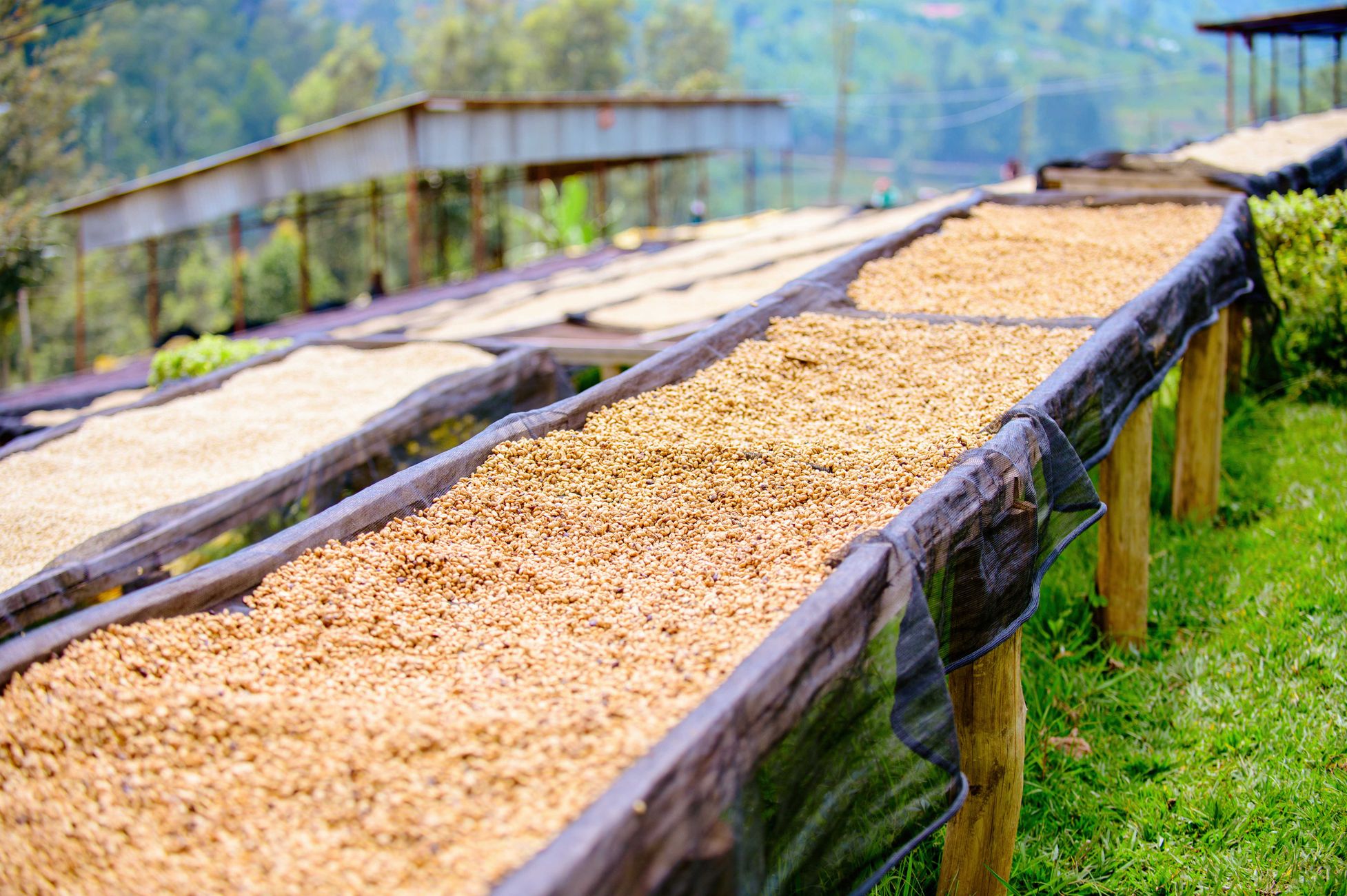
A raised bed is a simple thing: a mesh or screen surface stretched on a frame, standing roughly waist high, often under a shade structure that can be closed against rain. In East Africa they are so common that people call the technique African beds.
The difference is air. Coffee on a raised bed has moving air on all sides of it, including underneath, because the mesh lets the breeze through. Nothing is touching a hot slab. The coffee can be spread in a thin layer, sometimes only a couple of beans deep, because the bed area is cheap to expand and the whole point is exposure.
That combination changes the drying curve. The coffee dries more slowly and much more uniformly, from every side at once instead of from the top down. Workers turn it by hand several times a day, and because the layer is thin, turning it actually mixes it rather than just rearranging a pile.
Raised beds cost more. They require materials, construction, maintenance, far more surface area for the same volume, and considerably more labor per kilogram. Nobody builds them for fun. Producers build them because buyers pay for the cup they produce, which is a reasonable summary of how quality in this industry gets funded at all.
Buy coffee where the extra work shows up in the cup.
Case Hardening, and Why Speed Is the Enemy
The most damaging thing that fast, uneven drying does has a name borrowed from metalworking.
If the outside of a bean dries much faster than the inside, the exterior becomes hard and much less permeable. Moisture trapped in the center can no longer escape easily. You now have a bean that measures correctly on a moisture meter, because meters read an average, while actually holding a wet core inside a dry shell.
Over the following weeks that trapped moisture migrates back outward and redistributes. The result is a coffee that seemed stable at the mill and develops off flavors in storage. Sometimes it molds. More often it simply fades much faster than it should, tasting fine at first and papery within a couple of months.
Case hardening is a direct product of aggressive drying, and aggressive drying is much easier to cause on a hot slab than on a shaded, ventilated bed. This is why the best drying protocols are deliberately slow, often stretching to two or three weeks, with the coffee moved into shade during the hottest hours of the day.
Why Uneven Moisture Wrecks the Roast
Here is the connection that most drinkers never get told, and it is the reason drying quality reaches your cup so directly.
A roaster loads a batch and applies one heat profile to all of it. That profile assumes the beans are reasonably consistent, because the roast is timed around when the coffee will hit first crack and how long development needs to run.
Beans with different moisture content do not roast at the same rate. Wetter beans take longer to reach first crack, because more energy goes into evaporating water before anything else can happen. Drier beans race ahead. In a lot with a wide moisture spread, first crack does not happen as an event, it happens as a long scattered series of pops, and there is no single correct moment to drop the batch.
Whatever the roaster chooses, part of that batch is wrong. Some beans are underdeveloped, contributing sourness and a dry, grassy edge. Others are pushed too far, contributing flat roast notes. They all go into your grinder together, and the cup is the average of two mistakes.
This is why professional buyers care about moisture consistency almost as much as average moisture, and why they measure water activity in addition to moisture content. Water activity describes how available that water is rather than how much of it there is, and it predicts shelf stability far better. Well dried coffee typically lands around 0.55, and a lot arriving with high water activity is a lot that will not age gracefully no matter how good it cups today.
What Good Drying Tastes Like
You cannot taste a drying bed directly. What you can taste is clarity.
A carefully dried coffee has defined flavors. If it is a natural, the fruit reads as a specific fruit rather than a generalized sweetness, and there is no boozy or vinegary edge sitting underneath. If it is a washed coffee, the acidity is clean and the finish is transparent rather than dusty.
Poorly dried coffee tends toward the muddled. Flavors overlap into something vaguely fruity and vaguely fermented, there is often a mustiness in the aroma, and the finish carries a hint of damp cardboard. It also loses whatever it had faster, so the bag that tasted acceptable on day five tastes tired on day twenty.
The other tell is consistency between cups. A well dried, evenly roasted coffee tastes like itself every morning. A lot with a wide moisture spread produces cups that wander, which people usually blame on their own technique.
What to Look For
Roasters who buy carefully tend to say so, so labels and product pages are worth reading closely.
Look for the drying method named directly: raised beds, African beds, patio, mechanical dryer, or a combination such as beds followed by a finishing dryer. Look for drying duration, since anything in the range of twelve to twenty five days signals a deliberately slow process. Look for the harvest year, which tells you whether the coffee is current crop.
And notice when a roaster can tell you these things at all. Knowing how a lot was dried means knowing who dried it, which means the coffee came through a relationship rather than an anonymous container. That is usually the more meaningful signal.

The Short Version
Drying is the longest step in coffee processing and the one most likely to undo everything that came before it. A concrete patio heats coffee from below and only ventilates the top of the pile. A raised bed surrounds it with moving air and lets it dry thin, slow, and evenly.
Even drying means beans that roast together instead of fighting each other, and a cup that tastes like one clear thing. It costs the producer real money and real labor, and it is a large part of what separates coffee that tastes specific from coffee that tastes vaguely brown.
All images shown in this blog are sourced from pexels.com.