


You have a pour over recipe that works. Twenty grams of coffee, three hundred and twenty grams of water, a medium grind, two and a half minutes. It is dialed in and it produces a cup you genuinely like.
Then people come over and you need four cups instead of one. The math is easy. Multiply everything by four. Eighty grams of coffee, twelve hundred and eighty grams of water, same grind, and the result is disappointing in a way that is hard to name. Not broken. Just flatter, a little bitter at the edges, somehow less than the single cup you make every morning.
The ratio did not lie to you. It just stopped being the only thing that mattered, because several other variables that were negligible at small volume became significant at large volume. Once you know which ones, scaling up stops being a gamble.
Whatever size you brew, the beans set the ceiling. Browse our most popular roasts and then fix the method around them.
Why Ratio Is Not A Complete Recipe
A ratio tells you the relationship between coffee mass and water mass. It says nothing about geometry, and geometry is what changes when you scale.
Consider the coffee bed. Twenty grams of grounds in a cone forms a bed of a certain depth. Eighty grams in a larger cone forms a bed that is deeper, sometimes much deeper, because brewer diameter does not increase proportionally with capacity. Water has to travel through that entire depth, and the distance it travels determines how much contact it has and how much resistance it meets.
Doubling the coffee does not double the bed area. It mostly increases bed depth. That single fact drives most of what goes wrong.
Bed Depth And The Flow Problem
Water percolating through a coffee bed follows something close to Darcy's law, where flow rate depends on the pressure driving it and the resistance of the medium. Resistance scales with the depth the water must traverse.
A deeper bed means slower flow at the same grind. Slower flow means longer contact time. Longer contact time at the same grind means more extraction, and past a point, over extraction.
So your large batch runs longer than four times the small batch runtime, not because you did anything wrong but because the physics changed. A two and a half minute single cup can become a six or seven minute large batch, and those extra minutes are extracting bitter compounds you never reach in the small version.
This is also why the bottom of a deep bed behaves differently from the top. Water arriving at the bottom has already picked up dissolved solids from the coffee above it. Coffee dissolves into water more slowly when that water is already loaded with solubles, an equilibrium effect. The bottom of the bed under extracts while the top over extracts, and the two problems do not cancel out. They coexist in your cup.
The Fix Is Grind, Not Ratio
The first and most important adjustment when scaling up is going coarser.
This feels wrong to people. You are brewing more coffee, so shouldn't you extract harder? No. The deeper bed is already extracting harder through extended contact. Coarsening reduces surface area and increases permeability, letting water move through at a reasonable pace.
How much coarser depends on the jump. Going from twenty to forty grams might need one or two clicks on a typical grinder. Going from twenty to eighty might need three to five. There is no universal number because bed depth depends on your specific brewer's geometry.
The target to aim for is total brew time. If your one cup recipe finishes in two and a half minutes, a four cup batch should probably finish somewhere between four and five and a half minutes, not ten. Adjust the grind until you land there, and the extraction will be in a reasonable place.
Temperature Loss Becomes Real
At small volume, heat loss during the brew is minor. Three hundred grams of water poured over sixty to ninety seconds does not lose much before it is through.
At large volume, the brew runs for five or six minutes. The slurry sits exposed to air the whole time. A ceramic brewer that was not preheated is pulling heat out of the water continuously. By the last third of a large pour over, the effective brewing temperature can be fifteen or twenty degrees lower than when you started.
That temperature drop reduces extraction rate, which partly counteracts the longer contact time, but unpredictably and unevenly. The early water extracted at 200 degrees and the late water at 180, and you are drinking the average of two different brews.
Preheating matters much more at scale. Run hot water through the brewer and the carafe first. Use a brewer material with lower thermal mass or better insulation. Some people start large batches with water a few degrees hotter than they would use for a single cup, specifically to account for the loss, which is reasonable as long as the initial contact is not so hot that it scorches.
Pouring Technique Stops Scaling
A single cup pour over is a manageable act. You bloom with forty grams, wait, then pour in two or three stages, and the whole thing takes ninety seconds of attention.
A twelve hundred gram pour is a different physical task. Your kettle probably does not hold that much, so you refill mid brew and the kettle temperature drops when you do. Your arm gets tired and your pour becomes less even. The sheer volume means you are pouring in more stages, and every stage is a chance to disturb the bed unevenly.
Agitation from pouring also behaves differently. In a small bed, a pour that agitates the surface affects most of the coffee. In a deep bed, surface agitation only affects the top layer, and the bottom sits undisturbed. You get stratified extraction where the top is well mixed and the bottom is a static column.
Pulse pouring in more, smaller stages helps. So does pouring in slow concentric circles rather than a central stream, which distributes water across the bed surface instead of drilling a channel down the middle.
Get the beans right first and the technique adjustments will actually be visible.
Where The Bloom Goes Wrong
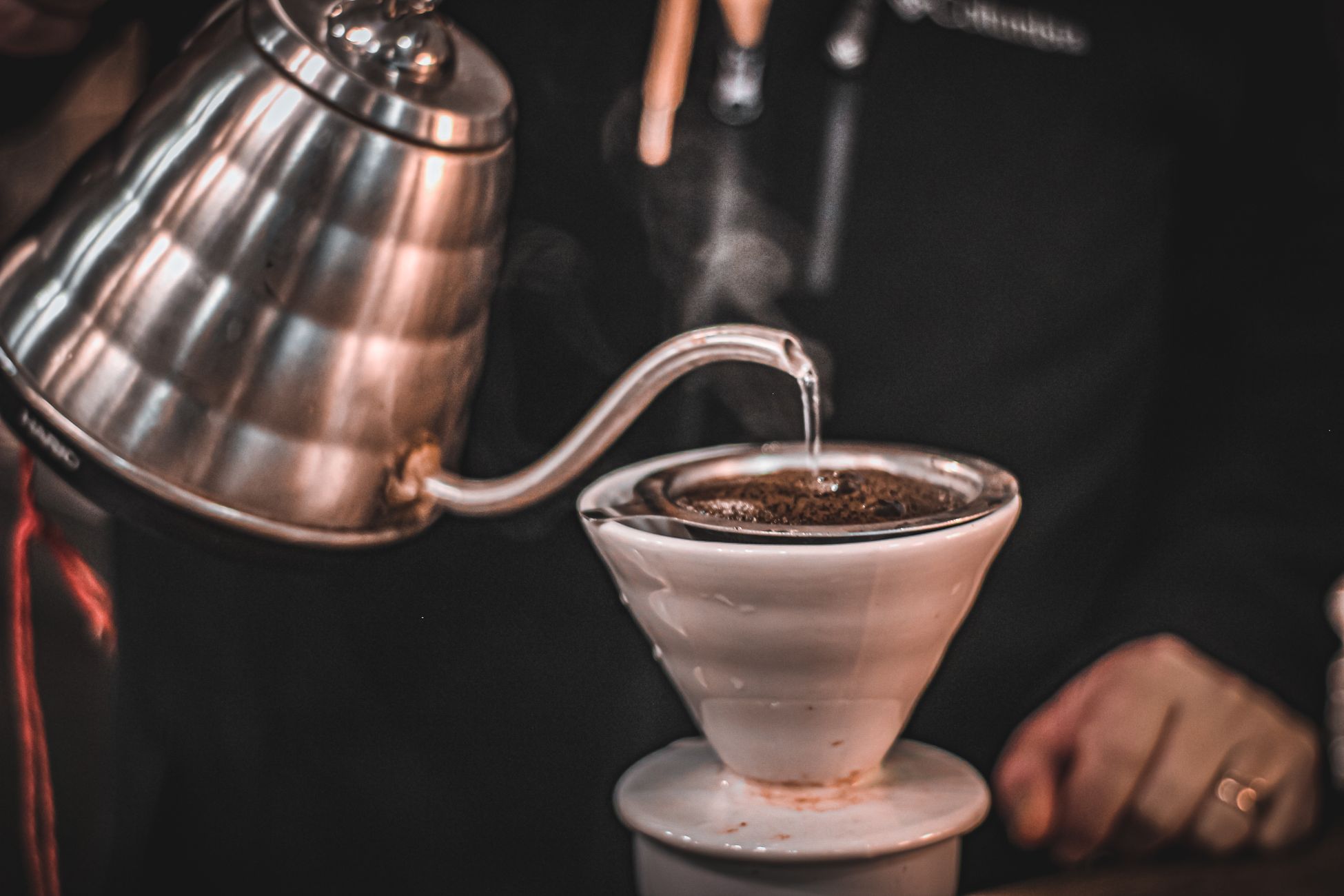
Blooming pre wets the grounds and lets carbon dioxide escape so it does not disrupt extraction later. The standard is roughly twice the coffee weight in water for thirty to forty five seconds.
At eighty grams of coffee, that is a hundred and sixty grams of bloom water, which is a lot of liquid sitting in a deep bed. It may start draining before the bloom finishes, which defeats part of the purpose. Fresh coffee will also produce dramatically more gas at this volume, and the bed can swell enough to overflow a brewer that was not sized generously.
Extending the bloom slightly, to sixty seconds, helps at larger volumes because the gas has further to travel to escape. Stirring the bloom gently, or using a spoon to make sure every ground is wetted, matters far more at scale than it does in a single cup where a swirl handles it.
When To Stop Scaling And Batch Differently
There is a point where a manual pour over is the wrong tool, and recognizing it saves frustration.
Most conical pour over brewers are designed for a range, and pushing past the top of that range means the bed depth is simply wrong for the geometry no matter what you do to the grind. A brewer designed for one to four cups is not going to be good at eight.
Above roughly sixty to eighty grams of coffee, the options that actually work better are a larger flat bottom brewer, which spreads the coffee into a shallower wider bed and largely sidesteps the depth problem, or a proper batch brewer, which is engineered for exactly this and controls temperature and flow mechanically.
Flat bottom is the more interesting answer for someone who wants to stay manual. Because the bed stays shallow as volume increases, the flow dynamics change much less. The same recipe scales far more gracefully.
What Does Not Change
Two things hold steady and are worth keeping fixed while you adjust everything else.
The coffee to water ratio itself is still the right starting point. Sixteen to one is sixteen to one at any volume. The ratio was never the problem. The variables around it were.
Roast quality still sets the ceiling. A large batch punishes an inconsistent roast more than a small one, because you are averaging across more beans and any scorched or underdeveloped material in the bag gets into the pot. Air roasting, which keeps beans suspended in moving air rather than in contact with a hot drum, produces a more uniform batch, and uniformity is exactly what a long extraction at depth will expose or forgive.
A Practical Scaling Method
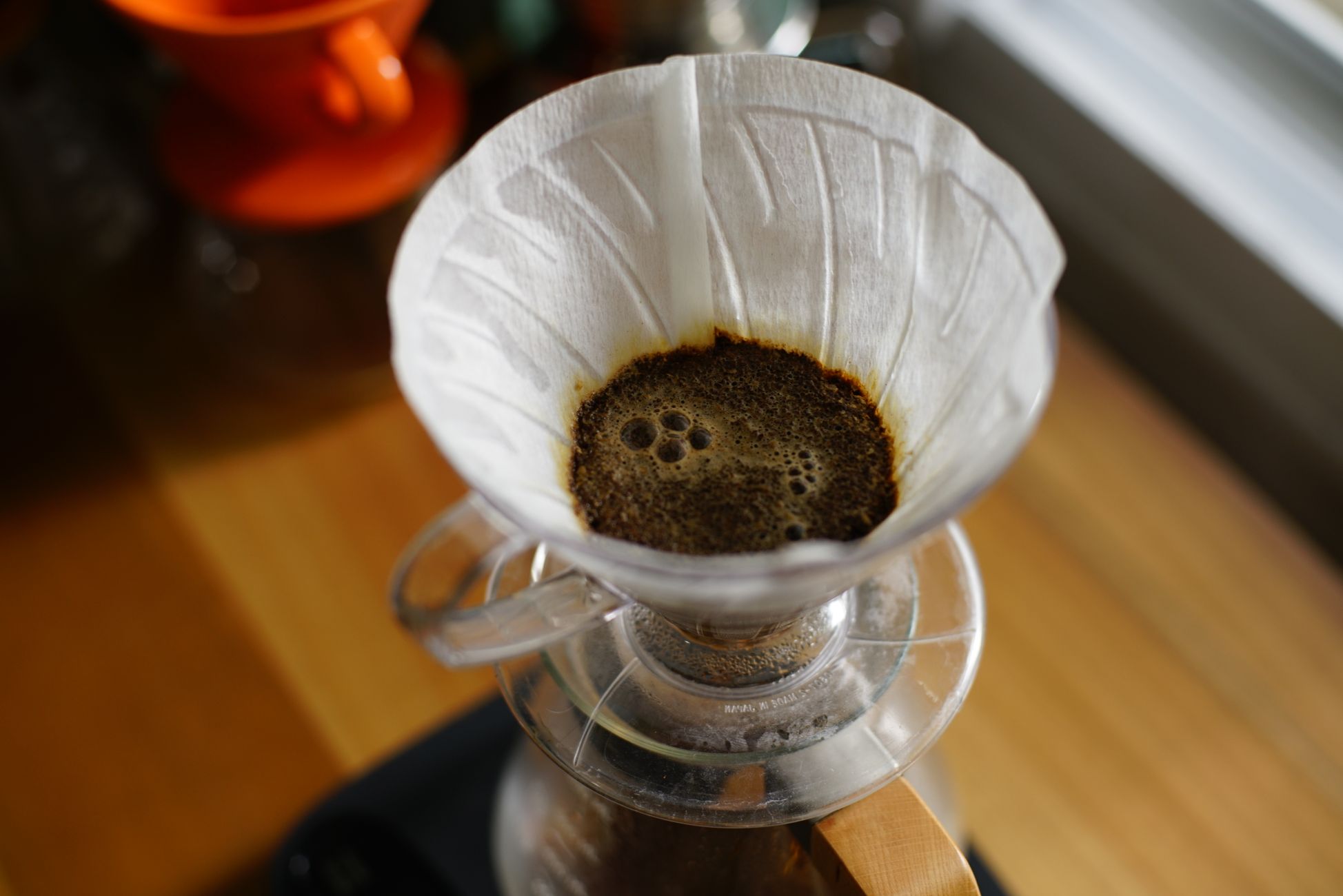
Keep your ratio. Coarsen the grind by two to four clicks for a doubling, more for larger jumps. Preheat everything thoroughly. Extend the bloom to about sixty seconds and make sure every ground is wet. Pour in more, smaller pulses. Target a total brew time roughly double your single cup time for a four times batch, not four times it.
Then taste and adjust one thing. If it is bitter and the brew ran long, coarsen more. If it is sour and thin, you probably overcorrected on grind, so come back finer a click. If it is both, your bed is too deep and you need a wider brewer, not a different setting.
The recipe you love is not wrong. It was just written for a specific geometry, and geometry is the thing nobody puts in the recipe.
All images shown in this blog are sourced from pexels.com.