


Everyone knows the smell. Walk into an office kitchen or a roadside diner in the late afternoon and there is a pot on a warmer that has been there since morning, giving off a burnt, sharp, slightly acrid smell that has nothing to do with coffee and everything to do with what happens to coffee when you keep cooking it.
The strange part is that the coffee in that pot was probably fine when it was brewed. Nothing about the beans, the grind, or the recipe changed. What changed is that the liquid sat on a heating element for hours, and a glass carafe on a hot plate is one of the most destructive pieces of equipment in the coffee world.
Brew something good enough to protect.
Brewing Ends, Chemistry Does Not
A common assumption is that once coffee is in the pot, it is finished and stable. It is not. Brewed coffee is a complex solution of hundreds of compounds, many of them unstable, sitting in hot water and exposed to air. Reactions continue for as long as the conditions allow, and heat accelerates every one of them.
The rough rule from chemistry is that reaction rates roughly double for every ten degrees Celsius of temperature increase. Coffee held at eighty degrees is degrading many times faster than the same coffee sitting at room temperature. A hot plate does not preserve coffee. It holds it in the condition where it falls apart fastest.
Three separate processes are running at once, and they take turns being the worst.
The Aromatics Leave First
The earliest loss happens within minutes, and it is the one most people never notice because there is no bad flavor to point at.
The aromatic compounds that make coffee smell like coffee are volatile, which means they evaporate readily. That is what an aroma is, molecules leaving the liquid and reaching your nose. An open carafe on a warmer is continuously boiling them off into the room.
This is why the office smells strongly of coffee while the coffee itself tastes of very little. The smell in the air is the flavor that used to be in the pot. Within about fifteen to twenty minutes on a warmer, a substantial share of the delicate aromatics are simply gone, and they cannot come back.
What remains is the heavier, less volatile stuff, which is disproportionately the bitter fraction. The cup starts flattening before it starts tasting wrong.
Oxidation Turns Acids Into Something Harsher
Coffee contains chlorogenic acids, which contribute to the pleasant brightness of a fresh cup. Under sustained heat and exposure to oxygen, they break down into quinic acid and caffeic acid.
Quinic acid is where that hollow, sour, stale flavor comes from. It is the specific taste of coffee that has been sitting, and it is unmistakable once you know what it is. It also brings a lingering astringency, that dry, rough feeling that stays after you swallow.
At the same time, the coffee oils are oxidizing. Those oils carry a great deal of flavor when fresh and turn rancid when they react with oxygen, contributing a stale, slightly greasy note.
Neither of these is reversible. This is chemical change, not temperature change, which is why reheating a cooled pot does not restore anything either.
Then It Concentrates
The third process is the simplest. Water evaporates from an open carafe on a warmer, and the dissolved solids do not.
An hour on a hot plate can remove a meaningful fraction of the water in the pot, which means the coffee left behind is more concentrated than the recipe intended. Bitterness and astringency scale with concentration, so a cup that was balanced at brewing strength becomes harsh at hour two purely because there is less water in it.
You can watch this happen. The level in the pot drops, the color darkens, and a scorched ring forms where the liquid line used to be. That ring is coffee solids baked directly onto glass at hot plate temperature, and it contributes its own burnt flavor to everything still in the pot.
Get beans that deserve better than a warmer.
What a Thermal Carafe Does Differently
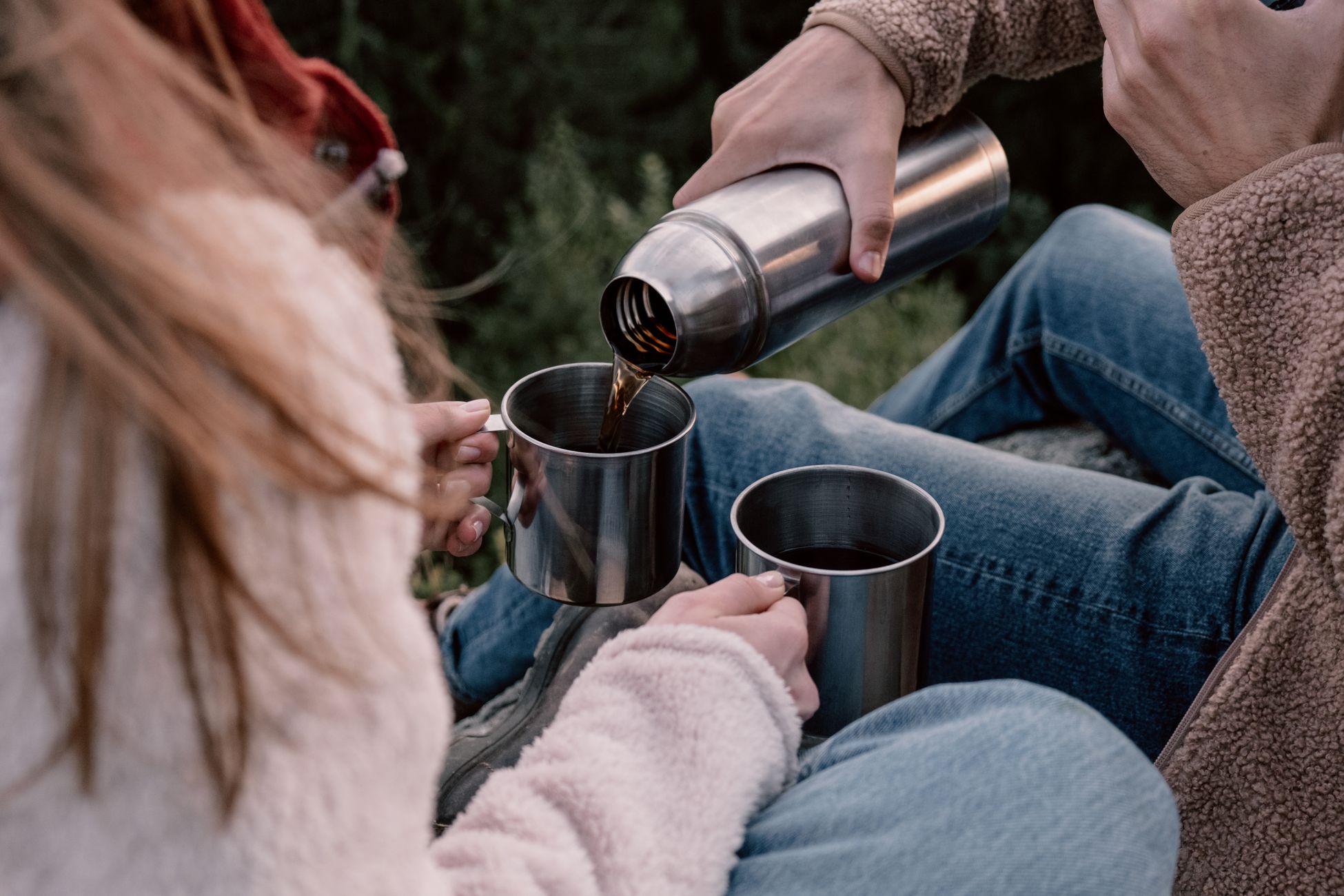
An insulated stainless carafe attacks all three problems at once, and it does it without any heating element at all.
It is sealed. A lid with a small dispensing mechanism dramatically reduces the surface area exposed to air. Fewer aromatics escape, and less oxygen reaches the liquid, which slows oxidation substantially.
It applies no heat. Vacuum insulation slows the loss of heat rather than adding any. The coffee begins cooling immediately from brew temperature, dropping through the eighties into the seventies over the first hour. Every degree it loses slows the degradation reactions further. The coffee is heading toward stability rather than being held at the point of maximum decay.
Nothing evaporates. A closed vessel means the concentration stays exactly where it was at the end of the brew, so the last cup has the same strength as the first.
Nothing scorches. There is no surface hot enough to bake solids onto, so there is no burnt ring and no burnt flavor.
The practical result is that coffee in a good thermal carafe is genuinely enjoyable for two to three hours and acceptable for longer. Coffee on a hot plate is past its best inside twenty minutes and unpleasant within an hour.
The Objection About Serving Temperature
The usual complaint is that thermal carafe coffee is not hot enough after an hour, and the honest answer is that it is cooler than hot plate coffee and tastes far better anyway.
Coffee served at seventy degrees that has held its aromatics beats coffee at eighty degrees that has lost them. Most people, once they have tried both side by side, stop caring about the temperature difference within a week.
There are ways to close the gap. Preheating the carafe with hot water before brewing makes a large difference, since a cold steel vessel absorbs a lot of heat from the first coffee that hits it. Filling the carafe closer to capacity helps too, because a small volume in a large vessel cools faster. Keeping the lid closed between pours is obvious and frequently ignored.
What This Means for Home Brewing
If your drip machine has a glass carafe on a warmer, the single highest impact change available to you is to stop using the warmer.
Brew into the glass carafe, then immediately pour what you are not drinking into any insulated vessel, even a travel mug. Switch the warmer off. That one habit removes the majority of the damage.
If you are buying a machine, buy the thermal carafe version. It usually costs slightly more and it is the difference between a second cup you look forward to and a second cup you tolerate.
If you brew manually, the same principle applies. A pour over sitting in an open server on the counter is losing aromatics too, just more slowly than on a warmer. Decant it into something insulated if you are not drinking it right away.
And if you find yourself with cooled coffee and no good options, drink it cool rather than microwaving it. Reheating adds a fresh round of heat driven degradation to coffee that has already been through one.

The Simple Version
Heat is what makes coffee, and after brewing it is what unmakes it. A hot plate holds your coffee at the exact temperature where aromatics escape fastest, oxidation runs quickest, and water evaporates steadily, and it adds a scorched surface for good measure.
A thermal carafe seals the coffee away from air and lets it cool slowly. Same beans, same brew, entirely different second cup.
Nothing else about your setup gives you that much improvement for that little effort.
Start with a bag worth pouring twice.
All images shown in this blog are sourced from pexels.com.