


Two people can own the same grinder, the same kettle, the same coffee, and the same scale, and get different results because one brews in a cone and the other brews in a flat bottom dripper. The shape of the thing is not a styling choice. It changes how water moves through coffee, and that changes what ends up in the cup.
If your pour overs are inconsistent, and especially if some mornings are great and some are baffling, the geometry of your dripper is worth understanding before you spend money on anything else.
Grab a bag worth brewing carefully.
What the Two Shapes Actually Are
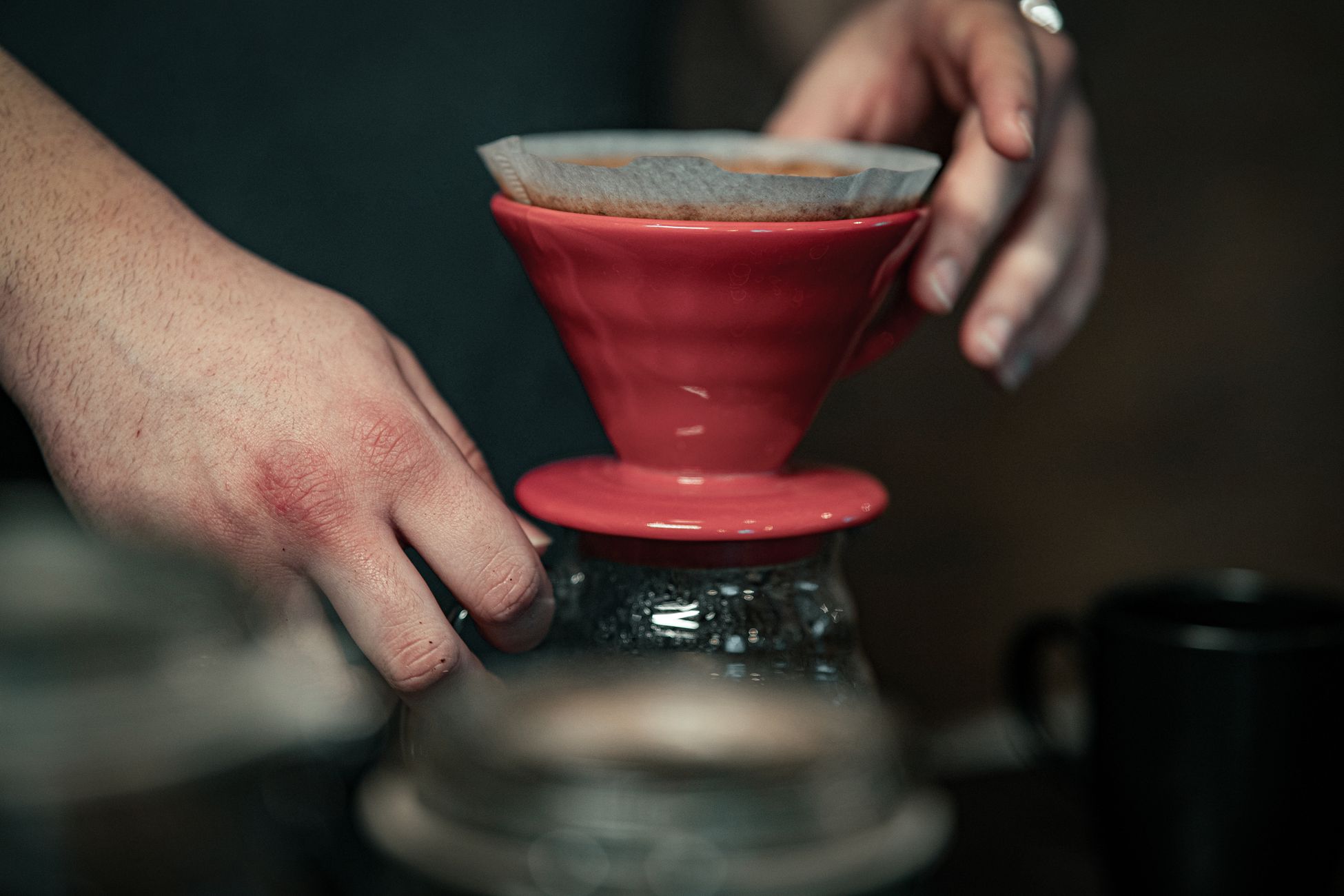
A cone is what most people picture when they hear pour over. The Hario V60 is the archetype: a 60 degree cone, one large hole at the bottom, and spiral ribs running up the walls. Origami, Kalita's conical models, and plenty of others share the basic form.
A flat bottom dripper has a wedge or basket shape with a flat base and small drainage holes. The Kalita Wave has three small holes and uses a fluted filter that stands slightly off the walls. The Fellow Stagg, the classic Melitta, and the basket in your office drip machine are all flat bottom designs.
The visible difference is the base. The functional difference is the coffee bed.

The Coffee Bed Is the Whole Story
Put 20 grams of coffee in a cone and it forms a deep pile that narrows toward a point. Put the same 20 grams in a flat bottom dripper and it forms a shallow, even layer across a wide base.
That difference in bed geometry drives everything else.
In a cone, water entering at the top has a long way to travel, and the path length varies enormously depending on where a given drop lands. Water dropped at the center goes almost straight down through a deep column of coffee. Water dropped near the edge travels down the wall and then inward toward the single exit hole. Those two paths do not extract the same amount, because they do not pass through the same quantity of coffee.
In a flat bottom dripper, every drop passes through roughly the same shallow depth of coffee before reaching the base. Path length is much more consistent across the bed, so extraction is much more consistent across the bed.
Why That Makes One Forgiving and One Demanding
Pour badly into a cone and you feel it. Dump water into the center and you drill a hole through the deepest part of the bed while barely touching the coffee at the perimeter. That center column gets hammered and over extracts, the edges get skimmed and under extract, and you taste both at once, which is the worst version of a bad cup because no single adjustment fixes it.
Pour badly into a flat bottom dripper and the shallow bed and multiple exit points absorb a lot of that error. Water spreads across the surface, the level evens out, and drainage happens through several points rather than funneling to one. The design is doing distribution work that a cone leaves entirely to you.
There is another factor. The Kalita style fluted filter holds the paper off the wall, so the bed does not seal itself against the dripper. Cones with straight walls can have the wet filter suction onto the surface, which alters flow unpredictably. The V60's ribs exist specifically to fight that, but it still happens.
Add it up and you get the practical summary that experienced brewers land on. A cone gives you a higher ceiling and a lower floor. A flat bottom dripper gives you a narrower band, closer to the middle, more often.
What Each One Tastes Like at Its Best
Neither one is objectively better, and anyone who tells you otherwise is describing a preference.
A well executed cone brew tends to be clearer, more separated, more articulate. The variable flow through a deeper bed produces a cup where individual notes stand apart from one another. For a delicate washed Ethiopian or a high grown Kenyan where you want the fruit distinct and the finish clean, a cone is hard to beat.
A well executed flat bottom brew tends to be rounder, sweeter, and thicker in the middle. More even extraction means fewer under extracted spots contributing sourness and fewer over extracted spots contributing harshness, and what you get instead is a fuller, more integrated cup. For a chocolate leaning Brazilian, a Sumatran, a blend, or a medium roast you want to taste as a whole rather than as parts, a flat bottom design flatters it.
Find a coffee that fits how you actually brew.
Grinding for Each
You do not use the same grind setting for both, and this catches people who switch.
Because a flat bottom dripper drains through small holes and holds a shallow bed, it needs a slightly coarser grind than a cone at the same dose to avoid choking. The three tiny holes in a Kalita Wave are a real restriction. Push a fine grind through them and you will stall.
A cone with one big hole is mostly limited by the coffee bed itself rather than the exit. That is why V60 users can go fairly fine and still finish, and why cone brewing gives you more room to use grind as a lever.
The general starting point: if you switch from a cone to a flat bottom dripper, go one or two clicks coarser and expect to adjust again after your first brew. If you switch the other direction, go finer.
Pouring for Each
Technique should change with the shape too.
For a cone, the standard advice is a slow, controlled spiral from the center outward and back, never pouring directly onto the paper, keeping the bed agitated enough that fines redistribute rather than settling into a plug at the tip. Cone brewing rewards attention throughout the pour. Some brewers use a gentle swirl at the end to level the bed and prevent a ring of dry coffee clinging to the wall.
For a flat bottom, you can be blunter and it will not punish you. Many people get excellent results with three or four big even pours and very little fuss. Keeping the bed submerged and flat matters more than tracing a perfect spiral. If anything, over agitating a flat bottom brew is more likely to cause problems than under agitating it, because fines pushed down into a shallow bed sit right on top of the exit holes.
Which Should You Own
If you are new to pour over and you want good coffee tomorrow morning rather than after a month of practice, buy a flat bottom dripper. It removes a whole category of failure and gets you to consistently drinkable coffee much faster.
If you already brew well, enjoy the process, own a decent grinder, and want to see how far a particular coffee can go, a cone gives you more to work with. The reason so many cafes use a V60 is not tradition, it is that in trained hands it produces the clearest cup available from a paper filter.
Owning both is not excessive. They cost very little compared to a grinder, and having both means you can match the brewer to the coffee, and to how awake you actually are.

The Point Underneath All of This
Every piece of brewing gear is a set of decisions about how water meets coffee. A cone decided to concentrate flow and deepen the bed, which buys clarity and costs consistency. A flat bottom decided to spread flow and shallow the bed, which buys consistency and costs some separation.
Neither company got it wrong. They optimized for different things, and knowing which thing you are holding tells you what to expect from it, what to blame when a brew goes sideways, and which adjustment will actually help.
That is worth more than another equipment upgrade. Most people do not need a better dripper. They need to know what the one on their counter is trying to do.
All images shown in this blog are sourced from pexels.com.