

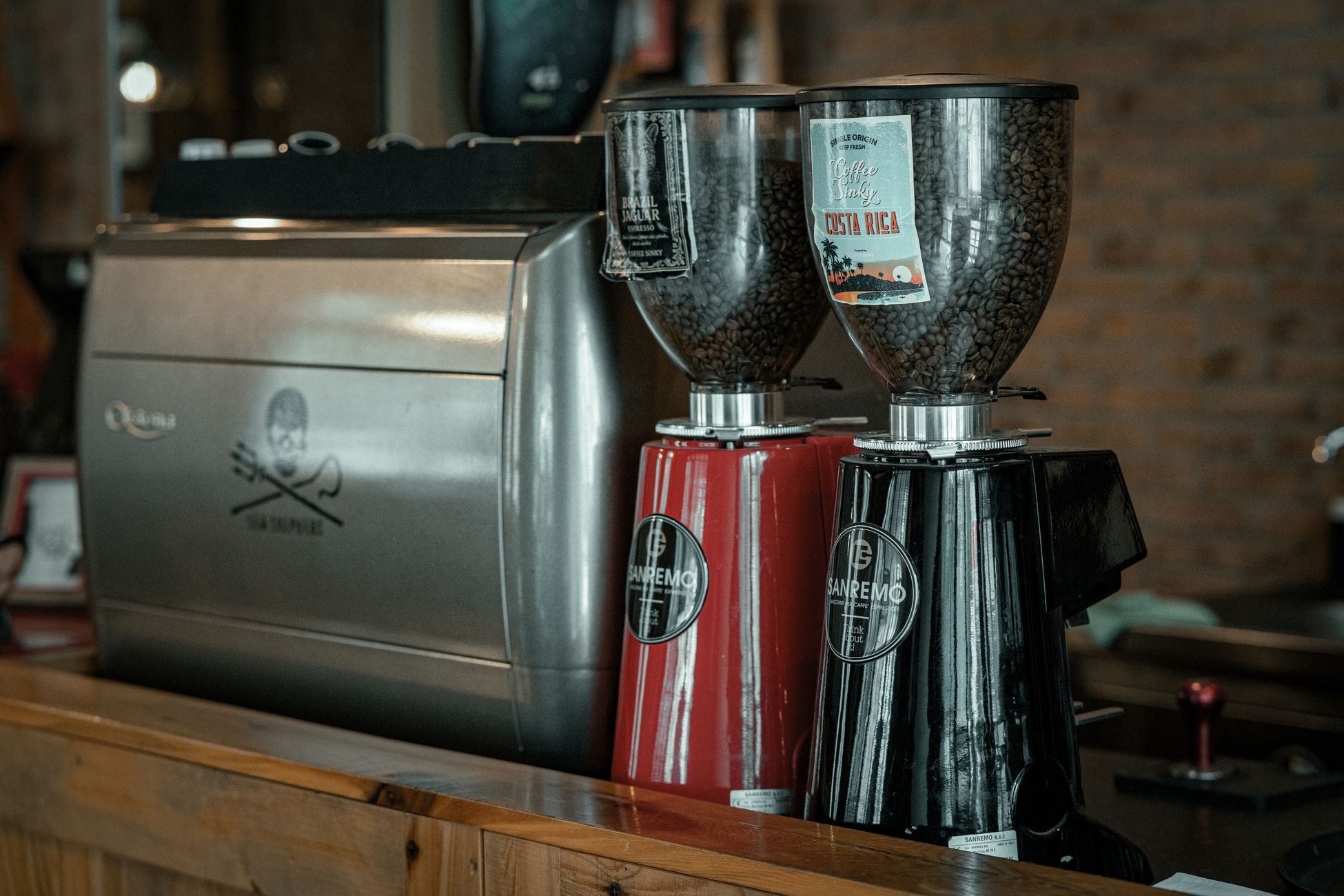
Ask a room of coffee people whether flat burrs or conical burrs make better coffee and you will get an argument that has been running for twenty years without resolution. That is usually a sign that the question is wrong.
Neither shape is better. They grind differently, they produce different particle distributions, and those distributions taste different in the cup. Which one you want depends on what you brew and what you want the coffee to do. Understanding the mechanism takes about ten minutes and saves you from buying the wrong grinder based on a forum thread.
Start with beans that reward a good grinder.
The Two Shapes
Conical burrs are a cone sitting inside a matching ring. The bean enters at the top, gets crushed between the cone and the ring, and travels downward through a gap that narrows as it goes. Gravity does most of the work moving coffee through, which is why conical grinders can run slower and still keep up.
Flat burrs are two parallel rings with cutting teeth facing each other. One spins, one stays fixed. Beans enter at the center and get thrown outward by centrifugal force, passing through a gap that stays the same width the whole way. Coffee only exits when it is small enough to escape the edge.
That difference in geometry, a narrowing vertical path versus a constant width horizontal one, is where everything else comes from.
What Each Shape Does to Particle Size
Every grinder produces a range of particle sizes, not a single size. Plot how much coffee falls into each size band and you get a distribution curve. The shape of that curve is the thing that actually matters.
Flat burrs produce a narrower, more concentrated distribution. Because coffee cannot leave until it fits through a fixed gap, particles get worked until they reach roughly the same size. The curve has one tall peak and comparatively little on either side of it.
Conical burrs produce a wider distribution, and on many conicals it is bimodal, meaning it has two peaks. There is a main population at the target size, plus a second smaller population of fines. The narrowing gap and the gravity fed path mean some particles get crushed several times on the way down while others take a fast route through and get processed less.
Neither curve is objectively correct. They extract differently.
Why That Changes the Taste
Extraction happens at the surface of a particle and works inward. A small particle gives up its soluble material fast. A large one gives it up slowly and may never fully finish.
With a narrow distribution, most particles finish extracting at around the same moment. Nothing is dramatically ahead and nothing is dramatically behind. The result tends to read as clean, separated, and specific. Individual flavors sit apart from each other and acidity comes through clearly. People describe flat burr coffee as transparent, or as tasting like the origin notes on the bag.
With a wider distribution, the fines finish early and the boulders are still going. You get overextracted material and underextracted material contributing to the same cup at the same time. That sounds like a defect and sometimes it is, but the overlap also creates the thing people call body. Flavors blend rather than separate. The cup reads as rounder, heavier, sweeter in a syrupy way, with more texture and less definition.
Fines matter more than their small mass suggests. They contribute a disproportionate share of dissolved solids because their surface area is enormous relative to their weight, and in espresso they also physically pack into the spaces between larger particles, which is part of why conical ground espresso often feels thicker.

Where Each One Wins
For filter brewing, especially light roast pour over where clarity is the point, flats generally have the edge. The whole reason to buy a washed Ethiopian is to taste what makes it different, and a narrow distribution shows you that with less muddling.
For espresso, it is genuinely split. Conicals are the classic espresso shape, and the reason is that heavy body and forgiving sweetness are exactly what an espresso is usually asked to deliver. A conical shot is more likely to taste good even when your dialing in is approximate. Flats in espresso give you a shot that is more articulate and more fragile. When it is right it is startling. When it is slightly off, the lack of blending means you hear about it.
For milk drinks, conicals often win outright, because the body and syrupy sweetness survive being diluted by six ounces of milk in a way that delicate separated acidity does not.
For dark roasts, it matters less than either camp claims. Dark roast has already compressed the flavor range, and the differences between distributions have less to work with.
Try a coffee that shows what your grinder can do.
The Practical Differences You Will Actually Notice
Retention. Flat burrs sit horizontally and coffee has to be pushed out by more coffee or by centrifugal force, so grounds hang around inside. Conicals are vertical and gravity fed, so less stays behind. If you switch coffees often, high retention means the first few grams of your new bag are yesterday's coffee. Single dose users care about this a lot.
Heat. Flat burrs run at higher rpm and grind by shearing across a wider contact area, which generates more heat. Heat drives off aromatics and, in extreme cases, changes how the coffee tastes. Bigger flats with proper cooling handle this. Small cheap flats sometimes do not.
Noise and speed. Flats are usually louder and faster at the same motor size.
Alignment. This is the one people underestimate. Flat burrs need to be genuinely parallel to grind evenly, and cheap flat grinders often are not. A misaligned flat burr grinder produces a wide messy distribution and loses the exact advantage you bought it for. Conicals are self centering by geometry and much more forgiving of manufacturing tolerance. A well made conical will beat a badly aligned flat every time.
Price. At the lower end of the market, conicals are usually the better buy for that reason. The gap closes as you move up.
How to Choose Without Overthinking It
Ask what you drink most.
Mostly filter, mostly light roast, and you care about tasting origin differences: flat.
Mostly espresso, mostly with milk, and you want a shot that is forgiving and rich: conical.
Both, on one grinder, on a budget: conical, because it does the harder job better and does the easier job acceptably.
Both, without a budget: two grinders, which is the real answer nobody wants to hear, because espresso and filter grind settings live so far apart that switching back and forth wears out your patience before it wears out the burrs.

The Part That Matters More Than Either
A grinder cannot add flavor. It can only fail to lose the flavor that is already in the bean. The most articulate flat burr grinder in the world, perfectly aligned, will still produce a boring cup from coffee that was roasted dark enough to erase its origin or that has been sitting open on a counter for a month.
The distribution debate only starts to matter once the coffee going into the hopper has something worth separating. A grinder upgrade on stale supermarket beans changes almost nothing. The same upgrade on a fresh single origin changes what you thought that coffee was.
Buy the shape that suits how you drink. Then feed it something that gives it a reason to exist.
Give your grinder something worth grinding.
All images shown in this blog are sourced from pexels.com.