

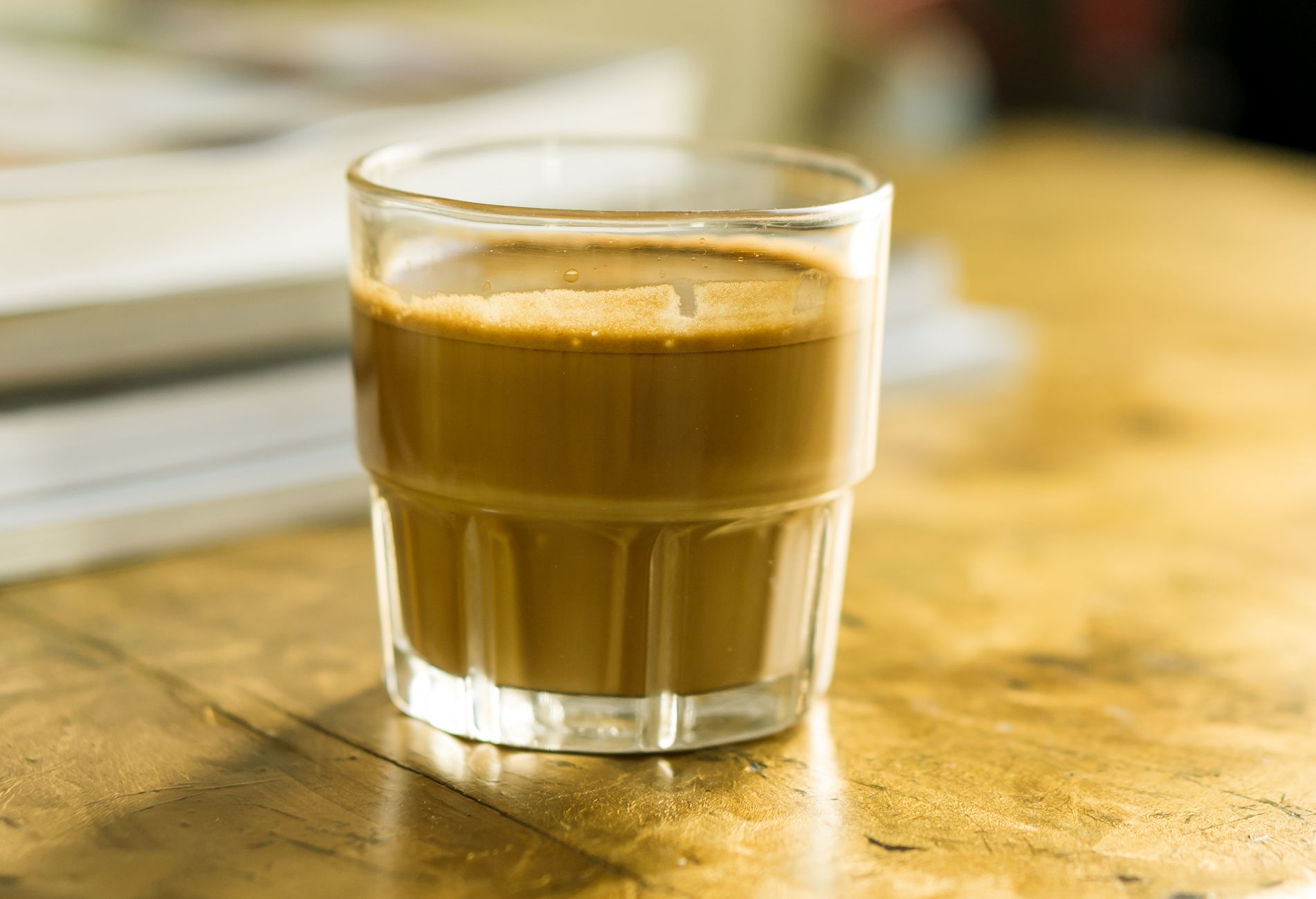
Order a cortado in three different cafes and you might get three different drinks. One arrives in a small glass, warm and dense, with barely a whisper of foam. Another shows up in a ceramic cup that looks suspiciously like a small latte. The third is served in a paper cup with a lid, which tells you the person making it never thought about what a cortado is supposed to be.
That inconsistency is not because the cortado is complicated. It is because the cortado is defined almost entirely by one thing, a ratio, and most people have never been told what that ratio is or why it matters. Once you understand it, the drink stops being a mystery and becomes one of the most honest ways to taste an espresso.
Shop the coffees we pull our cortados from
The Definition Is Simple
Cortado comes from the Spanish verb cortar, which means to cut. A cortado is espresso cut with an equal amount of steamed milk. That is the entire recipe. One part espresso, one part milk, and the milk is steamed with almost no foam so it stays liquid and integrates instead of sitting on top.
In practice that usually means a double shot, somewhere around 60 milliliters, and about 60 milliliters of milk, served in a glass or cup that holds around 120 to 150 milliliters. The drink is small on purpose. It is not a sipping drink you nurse for an hour. It is meant to be finished in a few minutes while it is still at temperature and the espresso is still fresh.
The drink comes from Spain, where it has been a standard cafe order for generations, and it spread through Latin America and later into specialty cafes in the United States. Along the way it picked up cousins. The Australian piccolo is close to a cortado but usually built on a single shot in a smaller glass. The Gibraltar, which you see in some American cafes, is literally a cortado served in a specific brand of glass tumbler that became popular in San Francisco. Same drink, different vessel, different name.

Why The Ratio Does All The Work
Every espresso and milk drink lives on a spectrum. At one end is a straight shot, all intensity and texture and no softening. At the other end is a latte, where a double shot is stretched into 300 milliliters of milk and the coffee becomes a flavor note rather than the main event.
The cortado sits at the exact point on that spectrum where milk has softened the espresso's edges without burying its character. One to one is enough milk to take the acidity down a notch and round out any harshness. It is not enough milk to cover up what the coffee actually tastes like.
This is why the ratio is the whole drink. Nudge it to one part espresso and two parts milk and you have a flat white territory drink where texture and sweetness start to lead. Nudge it the other way and you have a macchiato, which is espresso with just a spoonful of foam on top. The cortado only exists in the narrow middle, and that middle is what makes it useful.
What The Cortado Reveals About Your Espresso
Here is the part most people miss. Because a cortado uses so little milk, it exposes the espresso underneath. A latte is forgiving. You can pull a slightly bitter or slightly sour shot, drown it in steamed milk, and the customer will barely notice. A cortado does not let you hide.
If the shot is over extracted and bitter, the cortado tastes bitter. The milk softens it but it does not erase it. If the shot is under extracted and sour, you get a thin, sharp cortado that feels like something is missing. If the shot is pulled well, with sweetness and body and a clean finish, the cortado tastes like a rich, smooth, slightly sweet version of that exact coffee.
This makes the cortado an excellent test drink. Baristas use it to check their dial in without committing to a straight shot, which can be intense first thing in the morning. Home espresso drinkers should do the same. If you are trying to figure out whether a new bag is working with your machine, a cortado tells you more than a latte and is easier on the palate than a shot.
Try a cortado with beans that were roasted to taste like something
Why The Milk Has To Be Steamed Differently
The second half of the recipe is the milk texture, and it matters almost as much as the ratio. A cappuccino wants a thick cap of foam. A latte wants a silky microfoam you can pour art with. A cortado wants milk that is barely textured at all.
When you steam milk for a cortado, you introduce very little air. The goal is to heat it and give it a glossy, slightly thickened consistency without building any real foam layer. Some baristas describe it as steaming for texture rather than volume. The milk should pour like heavy cream, not like a milkshake.
There are two reasons this matters. First, foam takes up space, and in a 120 milliliter drink there is no room for it. A thick foam cap would push the ratio off and turn the drink into a small cappuccino. Second, foam changes the mouthfeel. The cortado is supposed to feel dense and unified, coffee and milk fully merged. Foam sits on top and separates the experience into a fluffy layer followed by a liquid layer, which is a different drink entirely.
The temperature is also lower than most people expect. Because the drink is small and meant to be consumed quickly, the milk is often steamed to around 55 to 60 degrees Celsius, cooler than a large latte. Cooler milk tastes sweeter, because the natural sugars in milk register more clearly before high heat starts to break them down. That sweetness is what makes a good cortado taste almost dessert like even though there is no sugar in it.

The Glass Is Not Decoration
Cortados are traditionally served in a small glass rather than a ceramic cup, and there is a practical reason. Glass shows you what you are drinking. You can see whether the barista integrated the milk properly, whether there is a foam cap that should not be there, and whether the drink fills the vessel the way it should.
Glass also loses heat faster than thick ceramic, which suits a drink that is meant to be finished quickly. A cortado that sits for twenty minutes in an insulated mug is a cortado that has gone lukewarm and lost its texture anyway. The glass is a quiet reminder that this drink is a moment, not a companion for the afternoon.
None of this means a ceramic cup ruins the drink. Plenty of excellent cafes serve cortados in small ceramic cups and they taste fine. But if you see a cortado arrive in a 12 ounce paper cup, the ratio is almost certainly wrong, and what you are holding is a small latte with a fancier name.
Choosing Coffee For A Cortado
Because the cortado exposes the espresso, the beans you use become the main decision. A coffee with real sweetness, a medium body, and a clean finish shines here. Think of coffees with notes of caramel, chocolate, red fruit, or stone fruit. Those flavors sit comfortably against milk and get amplified by its sweetness rather than muted.
Very light, very acidic coffees can work, but they take skill. The one to one ratio is not enough milk to fully balance sharp citric acidity, and you can end up with a cortado that tastes bright to the point of being sour. On the other end, very dark roasts turn a cortado into a smoky, bitter drink where the milk is fighting the coffee instead of complementing it.
This is where roast quality shows itself. A coffee roasted evenly, with its sugars developed and nothing scorched, gives you a cortado that tastes sweet on its own. Air roasting in particular tends to produce a cleaner cup, because the beans are suspended in hot air rather than tumbling against a hot metal drum, and the chaff is pulled away instead of burning into the batch. That cleanliness is exactly what a cortado rewards. Every flaw in the roast would show up in the glass, so the absence of flaws is something you can actually taste.
How To Make One At Home
If you have an espresso machine with a steam wand, a cortado is one of the easiest specialty drinks to get right, precisely because the recipe is so constrained.
Pull a double shot into a small glass or cup, around 120 to 150 milliliters capacity. Aim for roughly 36 to 40 grams of liquid espresso from 18 to 20 grams of dry coffee, which is a standard 1 to 2 ratio.
Steam about 60 to 70 milliliters of cold milk. Keep the wand tip just below the surface for only a second or two to introduce a small amount of air, then submerge it and let the milk spin until it reaches about 55 to 60 degrees Celsius. The pitcher should feel hot but not painful to hold.
Pour the milk into the espresso in one steady stream, keeping the pitcher low so the milk goes under the crema and integrates. Stop when the volumes are roughly equal. You should see a uniform tan color with a thin, glossy surface and almost no foam.
Drink it right away. A cortado has a short window where the temperature, texture, and espresso freshness all line up, and that window is why the drink is small.

Why This Drink Matters More Than It Looks
The cortado is not fancy. It does not have latte art or a tall glass or a whipped topping. But it might be the most useful drink in a cafe's lineup, because it is the one that tells the truth about what is going on behind the counter. A cafe that pulls consistent cortados is a cafe that has its espresso dialed in, its milk steaming under control, and its ratios understood.
For home drinkers it is the same lesson in reverse. If you can make a cortado that tastes sweet and balanced, your espresso is working. If your cortado tastes harsh or thin, the drink is telling you something about your grind, your dose, or your beans, and it is telling you honestly.
Start with coffee that was roasted to reward that honesty.
Find your next cortado coffee in our most popular collection
All images shown in this blog are sourced from pexels.com.